The mesh under
the sentence.
You say what you want. The machinery underneath establishes reality, finds the authority, routes the work, builds it, tests it, repairs what it is allowed to repair, proves the result, and keeps going.
It starts with something almost embarrassingly simple.
I talk.
Sometimes into Wispr Flow. Sometimes into ChatGPT Voice. Sometimes I throw in a transcript, a document, a pile of notes, or a half-formed idea that would make no sense as a traditional requirements document.
The important part is that I do not have to become the workflow.
I provide intent. I provide judgment when judgment matters. I provide authority when the consequence requires it. The mesh is supposed to do the rest.
Most “agentic” systems still quietly make the human their integration layer. You prompt. You copy. You paste. You reopen context. You approve the same thing twice. You move the artifact. You tell the next agent what the last one did. You discover the CI failure. You restart the run.
GhostMesh is the attempt to engineer that tax out of the system.
Simple on top.
Serious underneath.
A sentence like “build a data analysis app for this research, deploy it, and tell me when it is live” should not require me to decide which repository, runner, cloud surface, worker, model, deployment adapter, evidence store, or retry path ought to handle it.
Those are implementation decisions. The system should make them from governed state and policy.
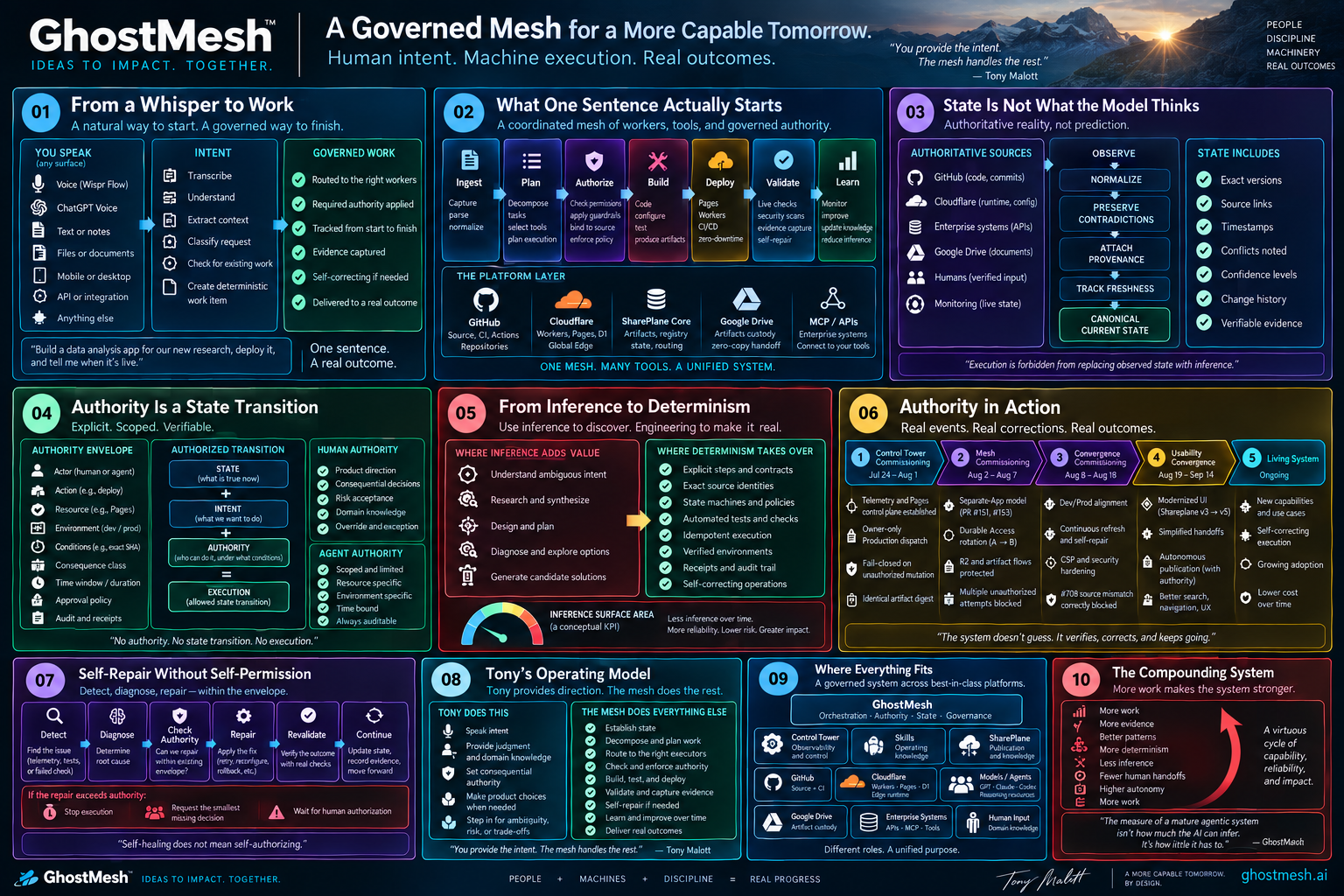
Underneath that one sentence, specialized workers ingest, plan, check authority, build, deploy, validate and observe. GitHub provides source and CI machinery. Cloudflare provides Pages, Workers, D1 and edge runtime. Drive can hold durable artifacts. Skills preserve operating knowledge. Control Tower observes and governs execution. Models and agents contribute reasoning without becoming the source of truth.
From a Whisper to a World of Possibilities
The human-facing workflow and the worker mesh beneath it.
State is not what the model thinks.
This is where the architecture gets less magical and more useful.
Before the system changes something consequential, it needs to know what is actually true now. That state can come from GitHub, Cloudflare, telemetry, enterprise systems, documents, explicit human decisions, or other authoritative sources. Every assertion carries provenance, freshness, identity and, when necessary, contradiction.
An LLM can help interpret reality. It cannot silently replace reality.
That sounds obvious until you watch a deployment system refuse to proceed because the source commit it actually observes does not match the source commit the authority contract expects. Then it becomes very concrete.
State, Intent, Authority, Execution
Observed reality constrains what may happen next.
Permission is too blunt a word.
Authority in GhostMesh is not “Tony said yes once,” and it is not “this agent has access.”
It is the bounded right to cause a particular transition from a known state: by a particular actor, against a particular resource, in a particular environment, under explicit conditions, with a known consequence class.
That separation is what allows humans and agents to participate in the same system without pretending they are interchangeable. A human can provide intent without authorizing Production. An agent can diagnose a defect without receiving permission to rotate credentials. A worker can repair a Development failure when the repair remains inside an existing envelope, then requalify and continue without waking me up.
If the repair exceeds the envelope, it stops. Self-repair does not mean self-permission.
The Governed Mesh
Human intent and machine execution connected by state, authority and evidence.
Inference discovers the path. Engineering hardens it.
Inference is incredibly useful when the problem is genuinely ambiguous: understanding intent, researching, synthesizing, designing, diagnosing, exploring alternatives.
But once we understand a path, continuing to ask a model to improvise it is not sophistication. It is technical debt wearing an AI badge.
The successful path should progressively become contracts, schemas, exact source identities, state machines, policies, tests, idempotency keys, receipts and deterministic workers.
That gives us a useful engineering metric: inference surface area. Every repeated successful outcome should reduce the amount of discretionary reasoning required the next time.
A More Capable Tomorrow. By Design.
The complete operating model, including the inference-to-determinism gradient.
The system learned by refusing to guess.
This is not a theoretical model drawn after the machinery was finished. The authority model was hardened by the machinery itself during commissioning, convergence and usability work.
Every time a boundary failed closed, we learned something about what should become explicit next.
Detected and blocked. The system preserved the owner-only Production boundary instead of assuming intent.
Credentials rotated A → B without downtime, with explicit scope and receipts.
Identical artifact digest established a deterministic equivalence claim rather than a visual “looks right” claim.
Execution responsibilities were split and narrowed instead of accumulating authority in one convenient worker.
An authorized Development deployment still stopped because observed source identity did not match the expected source contract.
Where authority, artifact, checks and state aligned, publication could proceed with receipts and without another human relay.
Authority in Action
Commissioning as a sequence of real corrections, not a victory lap.
I should be interrupted for judgment, not plumbing.
That is the destination.
I can start with a voice recording, a sentence, a document or an idea. The mesh establishes current state, decomposes the Work, chooses executors, checks authority, builds, tests, deploys, observes, captures evidence, repairs mechanical failures inside its envelope and continues.
I come back when the system encounters a real decision: competing product directions, ambiguity that changes intent, a consequential Production boundary that has not already been authorized, material security implications, destructive action, permission widening, or something else where human judgment is the point.
That is why the front end can eventually be almost anything: Wispr Flow, ChatGPT Voice, text, an API, an enterprise intake form, another agent, a transcript. The front end is not the architecture. It is simply where intent enters.
The Full Operating Model
One view of the worker fabric, authority boundary, platforms and outcomes.
Less guessing.
More getting done.
“The measure of a mature agentic system isn't how much the AI can infer. It's how little it has to.”